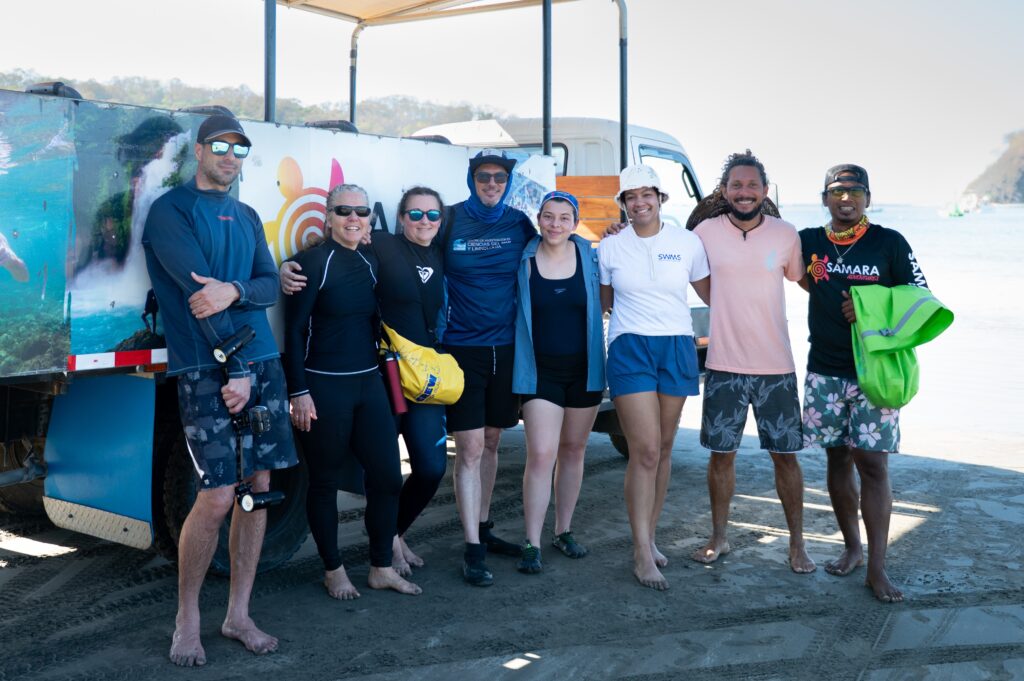
The Charney School is participating in a new international research project along the coast of Guanacaste, Costa Rica, aimed at understanding how reef-building corals cope with ocean warming.
The project is led by
Prof. Tali Mass and Dar Golomb from the Marine Biology Department, in collaboration with Fiorella Prada and Kayla Cayemitte from Rutgers University, and Juan José Alvarado and Mariana Mena Morales from the Centro de Investigación en Ciencias del Mar y Limnología at the University of Costa Rica (CIMAR–UCR).
The research focuses on coral reefs in Sámara Bay and the Gulf of Papagayo — regions characterized by seasonal upwelling of cold, nutrient-rich waters. These natural conditions create high thermal variability, which may influence corals’ ability to withstand heat stress.
During the fieldwork, the team conducts daily surveys at sea and examines various physiological metrics, including thermal tolerance, coral metabolism, and bleaching severity.
Additionally, the research integrates community work and collaborations with local restoration organizations — Asociación Proyecto Corales and Culebra Reef Gardens — working to restore and rehabilitate the region’s reefs.
Beyond the research activities, the project includes a significant training and capacity-building component: students from Israel, the United States, and Costa Rica participate in field sampling, experimental design, physiological measurements, and data analysis — as part of an international collaborative effort.
The research is supported by the University of Haifa Global Engagement Research Fund, the Rutgers Global Environmental Change Grant, and Peninsula de Papagayo.
The project emphasizes the importance of international collaborations and the need for a deep understanding of coral resilience mechanisms during a period of climate change. It reflects the School of Marine Sciences’ commitment to advancing high-quality marine research on the international stage, while training the next generation of researchers and conservation practitioners — for a resilient and sustainable future for coral reefs.